
6. Planning our first France campervan trip and the important admin
A laminated map, drywipe pens, a weather app, and absolutely no idea what we were doing. Here is the honest account of how we planned our first trip – the apps, the route, the paperwork you’ll need to arrange, and everything we’d do differently.

We’re Kate and Charlie – mid-fifties, one anxious dog called Huffle, one fifteen-year-old Peugeot Boxer campervan called Brigitte, and absolutely learning as we go. Whether you have a campervan or a motorhome, if you’re new to this or thinking about it, come with us.
IN A HURRY? THE SHORT VERSION
The essentials: get Park4Night for overnight stops (buy the offline maps before you leave).
Get the Camping Car Park card for French aires.
Order your Crit Air vignette at least three weeks in advance from certificat-air.gouv.fr only.
Fit a Campingaz adaptor before you leave – Calor gas is not available in France.
Pack a polarity tester for hook-ups.
Sort your dog’s Animal Health Certificate as soon as travel dates are confirmed.
Don’t over-plan the route – leave room to stop when something looks interesting.
We planned our first France trip with a laminated road atlas, a set of drywipe markers, a weather app, the Park4Night app, and a fairly significant amount of trepidation. We had never taken a campervan or motorhome out of the country. We had never spent a night in a French aire. We did not yet know what a Crit Air vignette was, or why polarity testing matters, or why you should always unroll your EHU cable before plugging in.
We know all of those things now. This is everything we did, everything we learned, and – most usefully – everything we would do differently.
Where to go – planning the route
We knew we wanted to go south, and we knew we wanted to go in January, which is the kind of decision that sounds eccentric until you arrive to find the Côte d’Azur quiet, sunny and entirely yours. Campsites in low season are peaceful and affordable. Roads are clear. Villages feel like they belong to the people who actually live in them.
We planned a rough arc: Le Shuttle at Folkestone, north France for the first couple of nights to break the drive, then a steady push south through Burgundy towards the coast. Beyond that, we left things deliberately open. This turned out to be the best decision we made.
Over-planning a van trip defeats the point of a van trip. The whole advantage of travelling at van pace is that you can stop when something looks interesting, stay longer than you meant to, and leave when you feel like it. A rigid itinerary fights against everything that makes this kind of travel worth doing.
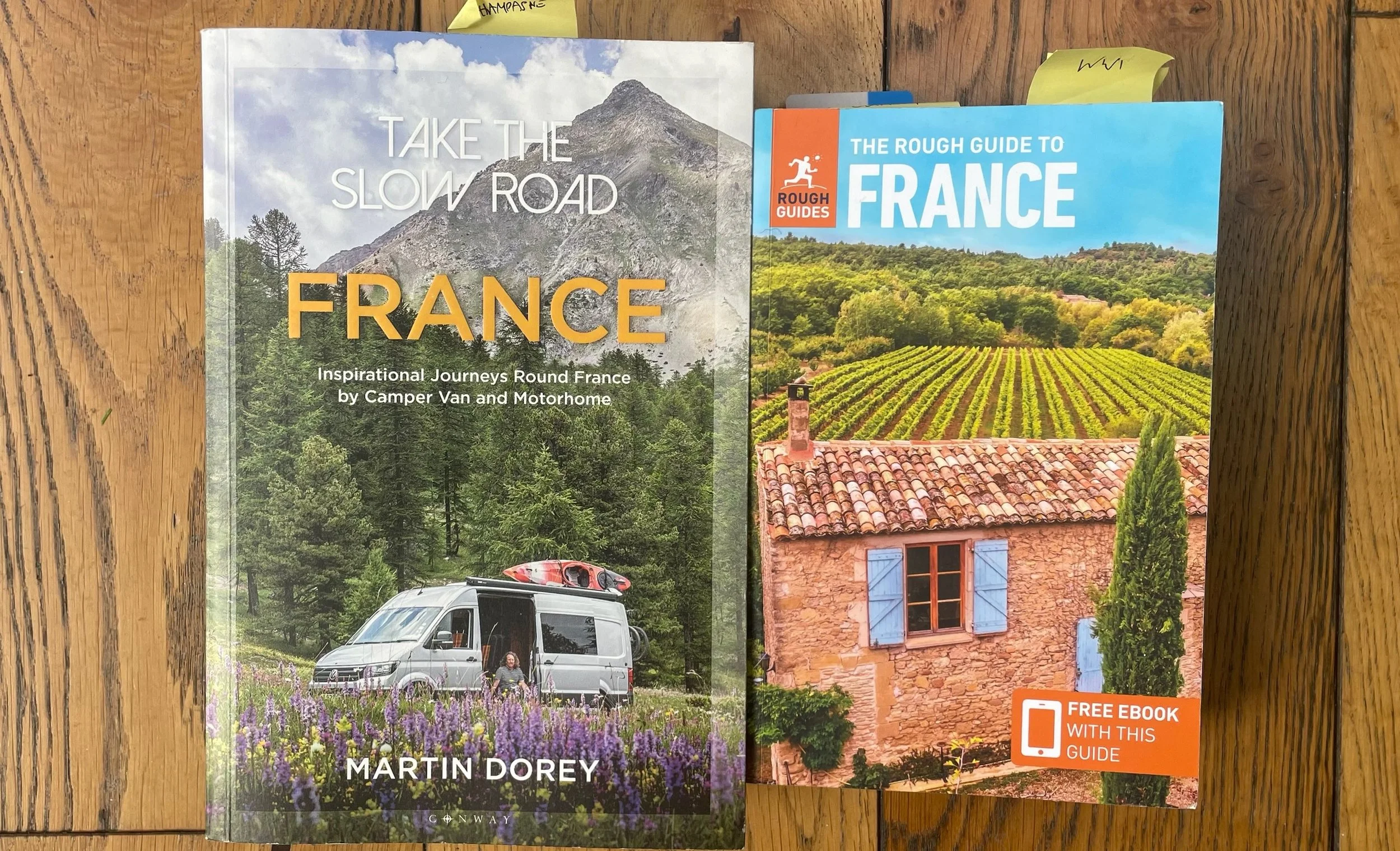
We used the Rough Guide to France for earmarking towns, markets and morning stops – read it in bed, browsed it over breakfast, turned down the corners of pages that sounded worth a detour. We used Park4Night to find actual overnight spots. These are two completely different jobs and both tools are worth having.
Park4Night – the single most essential app
Park4Night is the app almost every campervan and motorhome owner in Europe uses and we would not travel without it. It is a community-built map of overnight stops – aires, wild camp spots, campsites, parking areas – with user reviews, photos, practical information about facilities, cost, accessibility, and current conditions. We have found it indispensable.
The free version is useful. The premium subscription is worth every penny and costs almost nothing – it gives you offline maps, which matter considerably when you are in the beautiful middle of nowhere with no mobile signal, which is precisely where the most interesting spots tend to be.
Kettle & Keys tip: Download the offline maps for the regions you plan to visit before you leave. Don’t rely on having signal when you need to find somewhere to sleep. [LINK – affiliate] And always have a back up parking spot incase you don’t like the look of your chosen spot when you get there.
The Camping Car Park card – for French aires
Alongside Park4Night, the Camping Car Park card is the second planning essential for France. It is a prepaid card that gives you access to a network of official campervan and motorhome aires across France – most with hook-up, many with water and waste disposal, often very well positioned near town centres or on beautiful stretches of coast. They are essentially designated parking areas, but they are practical, well-maintained and well worth knowing about.
You load credit onto the card before you leave, arrive at an aire, tap the card at the barrier, and you are in. No app, no fuss, no needing to speak French at a barrier machine at 6pm when you are tired and hungry. The cost is typically between nothing and around €10–15 per night depending on the aire and the season.
We loaded ours with €50 before departure and had to top it up only once during the trip. The card itself costs very little and is worth having even if you only use it occasionally – it is the difference between arriving in a French town with a reliable place to park overnight, or driving around hoping to find somewhere.
Kettle & Keys tip: Order the Camping Car Park card well in advance of your trip. It arrives by post and takes a few days. You can load it with credit online at any point. [LINK]
The laminated road atlas and drywipe pens
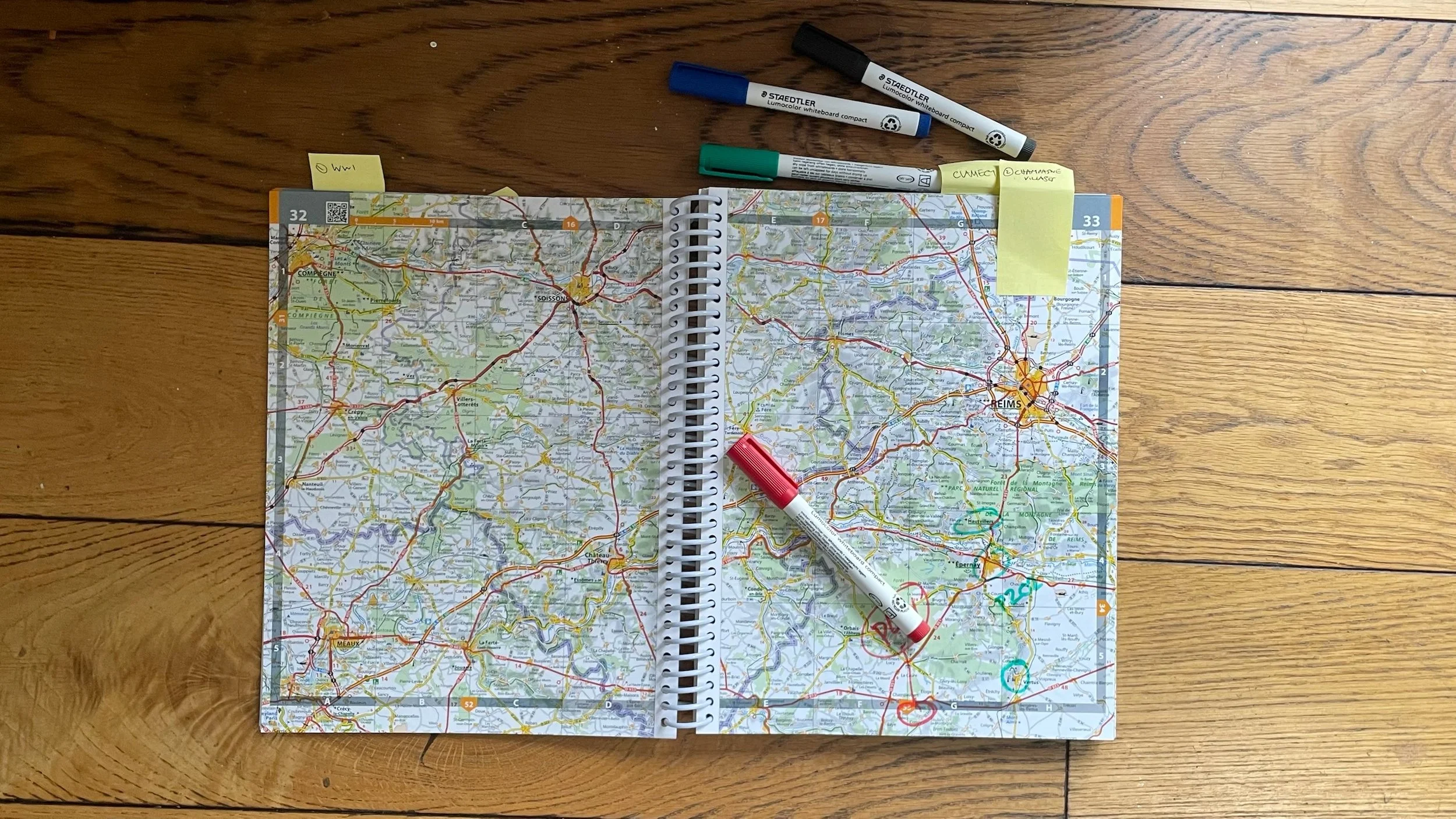
This sounds old-fashioned and it is. It is also brilliant. We bought a laminated A3 road atlas of France and a set of drywipe markers. We drew our rough route on it in one colour, marked things we wanted to investigate in another, and wiped it clean when plans changed – which they did, regularly, and pleasurably.
The laminated atlas earned its place for two reasons. First, it gave us an overview of the whole country that no phone screen replicates – you can see how far you have come, where you might go next, and what is in between in a way that scrolling on a small screen never quite manages. Second, it requires no battery, no signal, and no being distracted by notifications. It is just a map. You look at it. It shows you France.
Kettle & Keys tip: Get the drywipe markers in multiple colours and dedicate one colour to route, one to places of interest, one to aires you want to try. It sounds like faff but it is in fact excellent. [LINK – affiliate]
The gas bottle question
This is one of the things we were really pleased someone on YouTube mentioned before we left home. Most UK campervans and motorhomes run on Calor gas, which is not available in France. French motorhomes run on Campingaz, which is widely available across France and throughout Europe.
The solution is to fit a Campingaz regulator and pigtail hose before you leave, which allows your van to run on the standard French blue Campingaz cylinders available from supermarkets, petrol stations and camping shops throughout France. This is a straightforward job and costs very little – far less than trying to source Calor gas in France, which is essentially impossible.
Important: Fit the Campingaz adaptor before you leave, not when you arrive. If you run out of Calor gas on day two and have no adaptor, you will have no heating and no cooking until you find a solution. We fitted ours the week before departure and have never worried about gas since. [LINK – affiliate]
The polarity tester – the thing that doesn’t get mentioned often enough
Some French campsite hook-up points are wired in reverse polarity – meaning the live and neutral are the wrong way round. Your van will appear to work normally, but your RCD safety device (the circuit breaker that protects you from electric shock) may not function correctly, which is a problem you do not want.
A polarity tester plugs into your hook-up socket before you connect the van and tells you instantly whether the supply is safe. A polarity reverser corrects the problem if it is not. Both are small, cheap, and live permanently in our hook-up bag. We use the tester every single time we connect – it has become as automatic as putting on a seatbelt.
Kettle & Keys tip: Buy both before you leave. The tester and reverser together cost under £15 and live in your cable bag permanently. The first time you need them – and in France, you will need them at some point – you will be very glad you have them. [LINK – affiliate]
The admin that needs doing well before you leave home
There is a second category of France preparation that sits slightly apart from the planning – the administrative, the legal, the things with a lead time. None of it is difficult. All of it needs doing before you leave. Do it calmly at home and your departure will be a door closing and an engine starting, not a last-minute scramble.
The Crit Air vignette – order well in advance
If you are planning to drive in any French city – Paris, Lyon, Grenoble, Strasbourg, and an increasing number of others – you will need a Crit Air vignette. This is a colour-coded windscreen sticker that classifies your vehicle by its emission standard and determines which zones you are permitted to drive in and when.
Most modern campervans and motorhomes fall into Crit Air 1 or 2 – the cleaner categories – and are permitted in almost all zones. Older diesels may be Crit Air 3 or below, which carries more restrictions. Brigitte, being fifteen years old, is Crit Air 3, which means we are attentive to where and when we drive in city centres.
Order it before you leave – not when you arrive, not at the border, not from a French newsagent. Counterfeit versions are a known problem and using one carries a fine. Order the genuine vignette from the official French government website only: certificat-air.gouv.fr. It costs around 4–6 euros, arrives by post within two to three weeks, and is a single sticker that lives on your windscreen for the lifetime of the vehicle.
Important: Order your Crit Air vignette at least three weeks before departure. Driving in a low emission zone without one, or with a counterfeit, carries fines of up to 135 euros. Official website only: certificat-air.gouv.fr.
Kettle & Keys tip: Once fitted, the Crit Air sticker stays on permanently – you do not need a new one for each trip. Order once, display always.
The Animal Health Certificate (AHC) – book a vet early
If you are taking a dog to France or any EU country, you will need an Animal Health Certificate rather than the old-style pet passport. The AHC replaced the pet passport for travel from the UK to the EU after Brexit and is issued by a vet.
The AHC must be issued no more than ten days before you travel, which means you cannot arrange it weeks in advance and leave it in a drawer – you need to time the appointment carefully.
It is also worth shopping around, because vets charge very different rates for issuing one. Our own vet quoted us £250. We found a brilliant vet in Folkestone who charged £99. The process was straightforward: we asked our vet to email Huffle’s vaccination records to the Folkestone vet to confirm his rabies vaccination was current, filled in a short online form with his microchip number and our travel dates, and collected the AHC from the Folkestone vet just before we checked in at the Shuttle terminal. Easy, once you know how it works.
Your dog will also need a tapeworm treatment from a vet between one and five days before re-entering the UK. This is a separate requirement on the way home – arrange it at a French vet, which is entirely straightforward. Most campsite receptions can recommend one nearby and the treatment takes about five minutes.
Check that your dog’s microchip is registered and readable before the AHC appointment. The vet will scan it as part of the process and a chip that cannot be read is a problem worth resolving at home rather than at the border.
Important: The AHC cannot be issued more than ten days before travel. Book your vet appointment as soon as your travel dates are confirmed. Vets fill up quickly in peak periods.
Kettle & Keys tip: Shop around for your AHC – prices vary considerably between vets and the document is identical regardless of who issues it. Some online vet services offer home visit AHC appointments which can be more convenient if your regular vet is hard to get to.
Kettle & Keys tip: Keep your AHC, pet vaccination card and insurance details in a clear file in your passenger door for easy, quick access at the border.
The dog food rule – buy it in France
You cannot bring meat-based dog food from the UK into France. Buy it in France instead. If you know your dog is fussy, introduce a French brand or a vegan dry food before you travel so it is not completely unfamiliar on day one. Huffle rejected four French alternatives and held out for rotisserie chicken. Smart dog.
The UK sticker – simple but required
Since the UK left the EU, the GB oval sticker that used to live on the back of every British car abroad is no longer sufficient on its own. You now need a UK sticker if your number plate does not already display the UK identifier with the union flag. Most modern plates do, but older plates and some personalised plates may not.
Check your rear number plate. If it shows GB, or has no national identifier at all, you need a UK sticker. They cost almost nothing, are available from any Halfords or online, and take thirty seconds to apply. The fine for not displaying one when required is the kind of thing that would ruin an otherwise excellent first morning in France.
Headlight beam deflectors – easy to forget
UK vehicles drive on the left, which means headlights are aimed slightly to the left. In France and the rest of Europe, traffic drives on the right – meaning your headlights, unadjusted, will dazzle oncoming drivers. You are legally required to correct this.
Headlight beam deflectors are small self-adhesive stickers that attach to your headlight lenses and redirect the beam. They cost about five pounds for a set, take ten minutes to fit, and are removed when you return home. The specific stickers you need depend on your headlight type – halogen, LED or HID each require a different placement. Your van’s manual or a quick search of the make and model will confirm which you need.
Important: Driving in France with unadjusted headlights is illegal. It takes ten minutes to fit beam deflectors and costs less than a coffee. Buy them before you leave, fit them the evening before departure. [LINK]
The European emergency driving pack
The AA and RAC both sell European emergency packs containing the legally required items for driving in France: a warning triangle, a high-visibility jacket, and in some countries a breathalyser. The warning triangle must be placed fifty metres behind the vehicle if you break down. The hi-vis jacket must be accessible from inside the vehicle – not in the boot.
We keep our emergency pack in the cab alongside the van documents, insurance certificate and breakdown cover details. If you have breakdown cover, confirm that it includes European recovery before you leave – standard UK policies often do not.
Kettle & Keys tip: Take a photo of all your documents on your phone and email them to yourself before departure – insurance, breakdown cover, V5, AHC, Crit Air. If anything is lost or stolen abroad, you have digital copies accessible from anywhere.
The water tank – before every trip
A campervan or motorhome water tank that has been sitting unused between trips will develop biofilm and bacteria that flushing alone will not clear. Tank sanitiser tablets or sachets – we use Puri Sol tank cleaner and clean tabs – dissolve in the filled tank, sit for the recommended time, and then flush through. Do this before every trip, not just the first one of the season.
Kettle & Keys tip: Keep a small stock of sanitiser sachets permanently in the van. They weigh almost nothing and the peace of mind they provide is disproportionate to their cost. [LINK]
What we’d do differently
We over-planned the first week and under-planned the rest, when it should have been the other way round. The first week of a van trip is when you are still learning how everything works, still calibrating how far you want to drive each day, still working out your rhythm. We would now give the first few days almost no fixed plans, and use the confidence that comes from having done it once to be more spontaneous thereafter.
And we would tell ourselves earlier: you do not need to arrive anywhere by a fixed time. The whole point of this is that you do not. Stop when something looks interesting. Trust that there will be somewhere to sleep. There always is.
We would also always aim to arrive at your chosen overnight spot in daylight. It’s really important for peace of mind to be able to assess a park-up while you can still see it properly.
The best things we saw on that trip were not on any list. They were the things we found because we had time, because we stopped on a whim, because we took the small road instead of the fast one. Plan enough to feel safe. Leave the rest to the road.
Things we used and recommend
Everything mentioned in this post, linked below.
Planning and navigation
Park4Night app (premium) The app that finds your overnight spot. Buy the offline maps before you leave. Essential. [LINK]
Camping Car Park card Pre-loaded card for French aires. Order before departure. [LINK]
Laminated France road atlas With drywipe pens to mark the route. Analogue and brilliant. [LINK]
Drywipe markers (fine-tip) For marking routes, points of interest, aires to try. [LINK]
Rough Guide to France For earmarking boulangeries, markets and morning stops. Lives in the van permanently. [LINK]
Van essentials for France
Campingaz regulator and pigtail hose Fit before you leave. The only gas system that works in both UK and France. [LINK]
Polarity tester Test every French hook-up before connecting. Every single time. [LINK]
Polarity reverser For when the tester finds a problem. Both live in the cable bag. [LINK]
Headlight beam deflectors Check your headlight type before ordering. Fit the evening before departure. [LINK]
Paperwork and legal
Crit Air vignette Order from certificat-air.gouv.fr only. Around 4–6 euros. Allow 3 weeks. [LINK]
Animal Health Certificate From your vet, max 10 days before travel. Book the appointment early. [LINK]
UK sticker If your number plate does not display UK with a union flag. [LINK]
European emergency pack Warning triangle, hi-vis jacket. From AA, RAC or equivalent. [LINK]
European breakdown cover Confirm your policy covers EU recovery before you leave. [LINK]
Water system
Water tank sanitiser tablets or sachets Use before every trip. Keep a stock permanently in the van. [LINK]
Collapsible 8L water carriers (x2) For filling the tank from a distance or carrying fresh water off-grid. [LINK]
Bendy funnel For the water filler at an awkward angle. Costs almost nothing. [LINK]
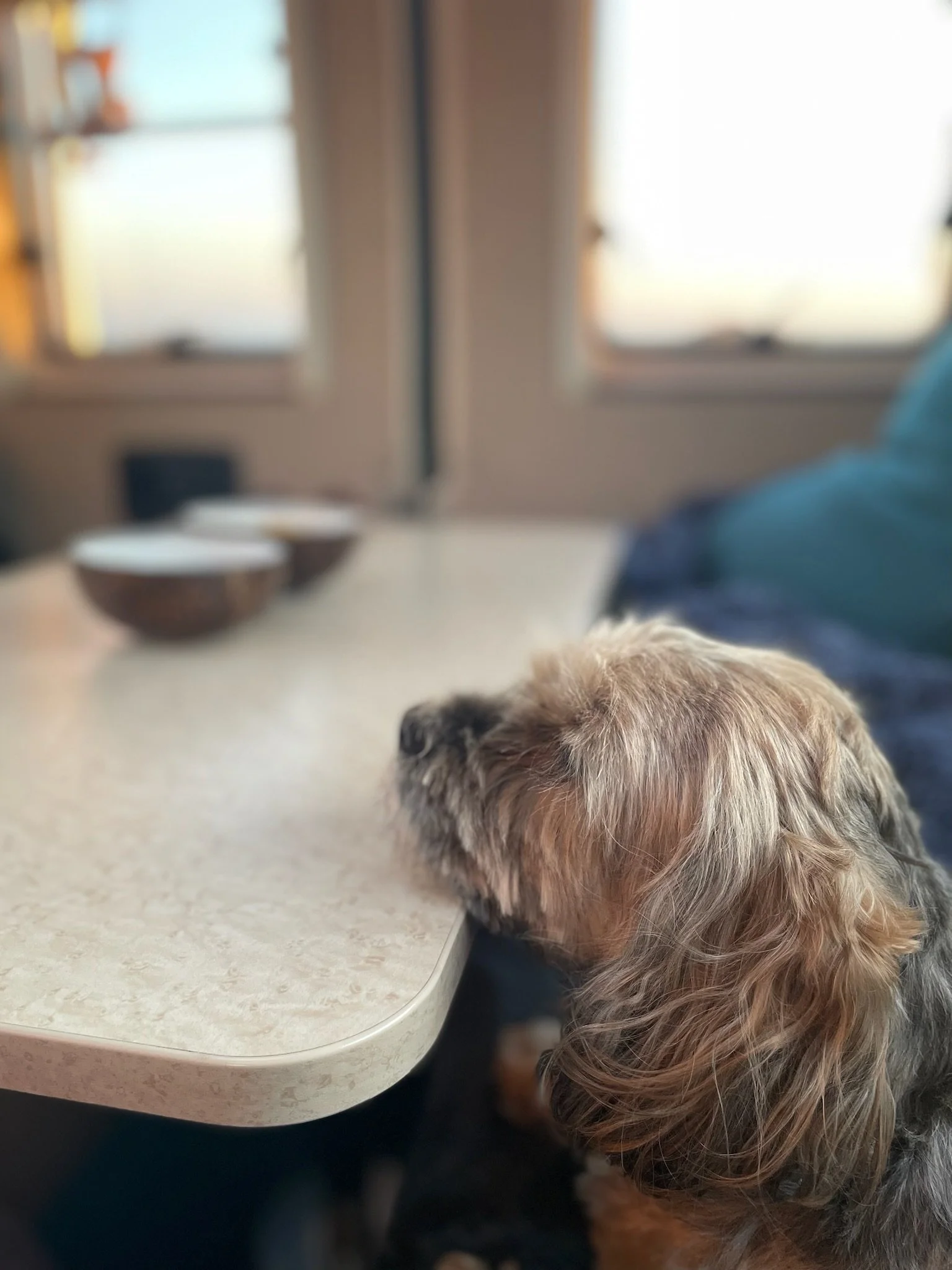
Kate, Charlie, Huffle & Brigitte
Kettle & Keys
comfort, wherever you park up.
Some links in this post are affiliate links, marked with [affiliate]. This means if you buy through them, we earn a small commission – at absolutely no extra cost to you. We only ever link to things we have genuinely used and would recommend to a friend regardless. It’s one of the ways we keep Kettle & Keys running, and we’re grateful for every click. Thank you for supporting us.