
7. 10 things we learned on our first campervan trip
We drove 2,500 miles from Cornwall to the south of France. In January. In a fifteen-year-old van. With an anxious dog. Here is everything we wish someone had told us first.
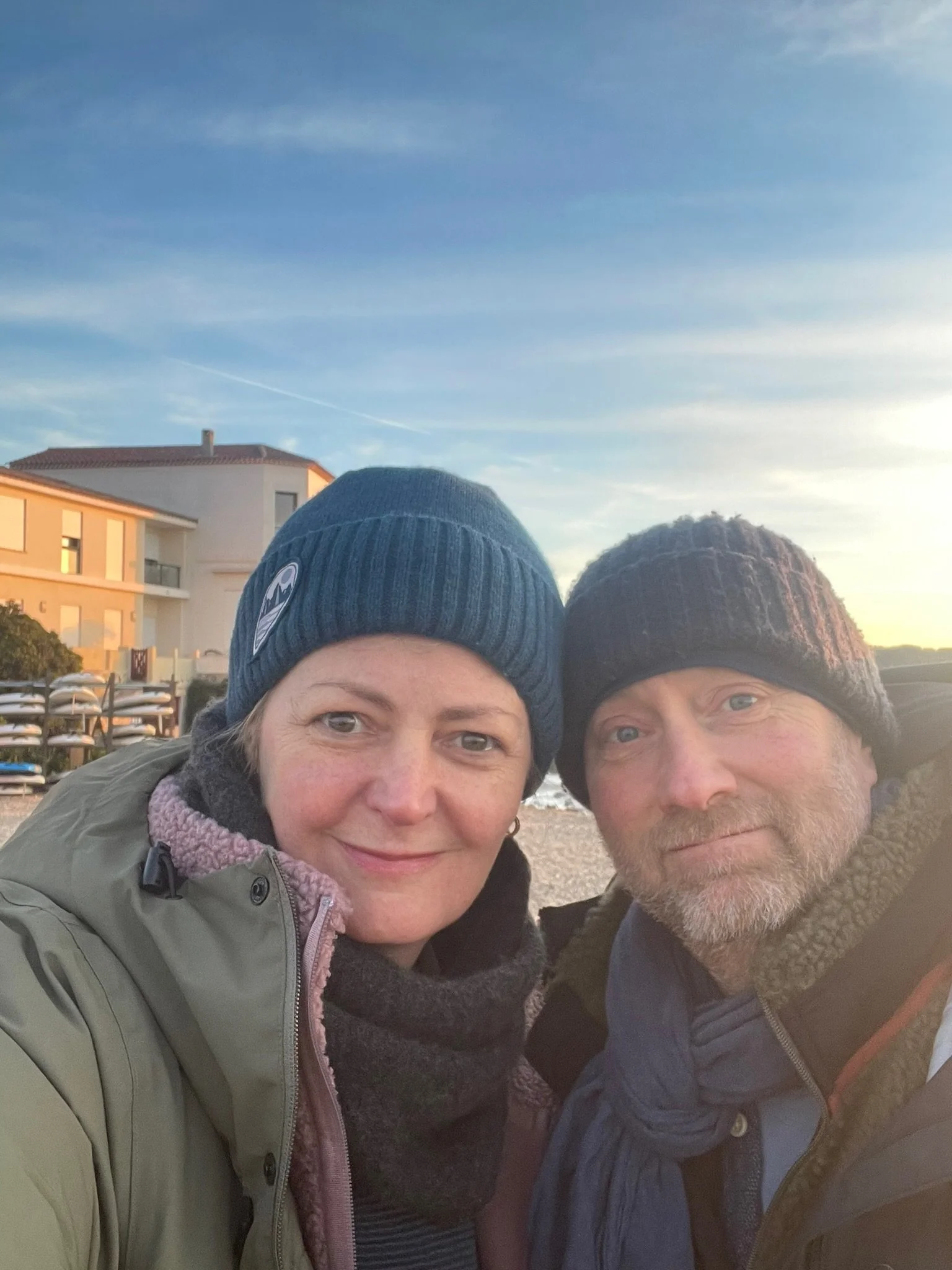
We’re Kate and Charlie – mid-fifties, one anxious dog called Huffle, one fifteen-year-old Peugeot Boxer campervan called Brigitte, and absolutely learning as we go. Whether you have a campervan or a motorhome, if you’re new to this or thinking about it, come with us.
IN A HURRY? THE SHORT VERSION
The ten things that made the biggest difference:
Aires are easy and unthreatening – get the Camping Car Park app before you leave.
Gas fittings are different in France – fit a Campingaz adaptor at home.
You will use far less gas than you expect.
The sleep hat is a game changer.
A duckboard in the shower room transforms it.
Put stuff away, don’t put it down.
Launderettes are brilliant.
Keep a bank card accessible at toll booths.
Be twenty-four hours ahead of yourself.
Crack a rooflight overnight to manage condensation.
We drove 2,500 miles in January when we drove from Cornwall to the Côte d’Azur and back. It was our first proper campervan trip. In January. In a van that was fifteen years old when we bought it. With a dog who had strong opinions about French dog food and expressed them clearly and at length.
We came home having made several entirely avoidable mistakes, learned an enormous amount, and had the best trip of our lives. Here are the ten things we’d tell ourselves before we left – and therefore the ten things that might help you.
1. Aires are much less scary than we thought
We’d read plenty about the legendary aires de camping-car before we left, but weren’t entirely sure what to expect. Would we be the only people there? Would it be bleak? Would we be taunted by BMX teenagers circling like matadors?
Not a bit of it. Most aires were simply tidy, tarmacked stopping areas – sometimes with hedges or fencing between pitches – perfectly civilised and entirely unthreatening. Here is how they work in practice:
· Download the Camping Car Park app (covers 600+ aires across France) and load it with credit – around 50 euros is a good starting amount
· Tap your card on the barrier on arrival and choose your pitch
· Fill up with fresh water and use the service point to empty grey and waste water
· Park up, plug in the electric hook-up, relax
Occasionally the app throws a small wobble, but the helpline answers promptly – often in English – and the humans on the other end are genuinely helpful. We were surprised by this. We should not have been. The French are very good at campervan infrastructure.
The lesson: In winter, when you tend to spend your evenings inside anyway, aires are brilliant. In spring or summer, spending those long warm evenings in a tarmacked car park might not be the dream. Worth knowing when you’re planning.
2. We used far less gas than we expected
We left Cornwall fully expecting to spend a significant portion of every French town visit hunting for ‘une bouteille de Campingaz’ and gesturing helplessly at things. The part-used 13-litre bottle we departed with was still going at the end of two and a half weeks.
That covered all cooking, all the boiling water for tea and coffee, and the considerable amount of bread-grilling that happened most mornings. What it didn’t cover was heating – because we were mostly on electric hook-up at aires and used the electric heater rather than gas. A genuine and pleasant surprise.
3. Gas fittings are different in the UK and France
This one nearly caught us out, so it’s worth knowing before you leave.
Most UK vans come fitted for Calor gas with a UK regulator. Calor is not available in France. There are French options – Butagaz, Primagaz – but they use different fittings and you’d need to buy a new regulator on arrival, which is not the relaxed start to a trip you’re hoping for.
The simplest solution, and the one we went with, is to switch to Campingaz before you leave – the only system readily available in both the UK and across Europe. You’ll need a new regulator and pigtail hose, both of which are straightforward to fit or have fitted before departure.
The lesson: Sort the Campingaz adaptor at home, calmly, not in a services near Calais. [LINK – affiliate]
4. Staying warm in winter is easier than we feared
Winter in France is properly cold – even in the south once the sun drops. Our first few days hovered around four degrees with an easterly wind and occasional snow flurries. Somewhere south of Calais we briefly wondered whether the gendarmes might eventually have to break into the van to thaw two frozen Britons and a small dog.
They did not. Here is what actually worked:
The electric heater on hook-up was the workhorse – half power kept the van at a comfortable 20 degrees during the evening. At night we turned the thermostat right down, which kept it at about 12 degrees with the boiler quietly doing its job. Warm enough with the right bedding – a fifteen-tog single duvet each (one each, not shared), sleep hats, and in Kate’s case full fleece pyjamas and bedsocks. Charlie went for what he describes as a minimalist approach. He was cold. He didn’t say so. We knew.
The sleep hat is an essential. Most body heat escapes through your head. A soft cotton beanie costs almost nothing, weighs nothing, and is the single most effective thing we found for a warm night. We wear them every trip now and we don’t care if we look ridiculous.
5. Top purchase: a duckboard for the shower room
Small. Inexpensive. Completely transformed the shower room experience.
A simple wooden duckboard for the shower room floor meant we were never stepping onto a wet surface in our socks – which, in a cold van in January, is a specific kind of unpleasantness that it turns out is entirely avoidable. It lives on the floor all day, comes out while you shower, goes back in after. The floor stays effectively dry, your socks stay effectively dry, and everyone is considerably happier. This is peak van thinking: a small, cheap thing that solves a problem completely.
The lesson: Duckboard. Shower room. Before your first trip. [LINK – affiliate]
6. Put it away, don’t put it down
A van is a small space and it reveals your domestic habits with a clarity that a house – with its spare rooms and cupboards and general capacity for absorption – simply doesn’t. Things that at home would sit on a counter for a day or two before being dealt with have nowhere to go in a van. They just live on the counter, multiplying, until the counter is full and the van feels chaotic and nobody can find the corkscrew.
The rule that changed everything for us was simple: put it away, don’t put it down. Everything has a place. When you’re done with it, it goes back to its place, immediately, not later. This sounds obvious. It is not instinctive. It takes a trip or two to become automatic. Once it does, the van stays ordered, everything is findable, and the whole experience is considerably more relaxed.
The van doesn’t lie about your habits. If you’re a ‘I’ll put it away in a minute’ person at home, the van will find you out within about half an hour. The good news is that the constraint is also the cure.
A related discovery: more hooks than you think you need. Coat hooks by the door, hooks in the shower room for wet dripping coats, a hook for the dog lead, hooks inside cupboard doors. Hooks are the making of a well-organised van and you will always wish you had more of them.
7. Launderettes are easy, cheap and oddly satisfying
We had not used a launderette in years and approached the French launderette experience with mild apprehension. This was unnecessary.
French launderettes – laveries automatiques – are clean, straightforward, and available in virtually every town of any size. Most are self-service with clear instructions, take card payment, and will wash and dry a full load in about an hour for around six to eight euros. You leave your washing, find a coffee and a baguette, pop back to put clothes in the drier and then a bit later come back to clean, dry clothes. This is an entirely reasonable way to spend an hour of a trip.
The lesson: Check the launderette location on Park4Night or Google Maps before you need it, not at the moment you need it – when you will be standing in a town centre with a bag of washing and no signal.
8. The péage toll booths – a few things worth knowing
French motorways are tolled. This is not a surprise if you’ve driven in France before, but the scale of it on a long trip is worth knowing about in advance. Our 2,500-mile trip involved a meaningful amount of péage, and a few things made it considerably smoother.
Use a bank card rather than your phone at the toll booth. Phone payments at French péage points are inconsistent and occasionally don’t work at all. A contactless bank card works every time. Keep it somewhere easily accessible from the driver’s seat – not buried in your bag.
A grabber (like a litter picker) – a simple reaching tool – is genuinely useful in a tall van where the toll machine is at car height and you are considerably higher than that. Stretching down from a campervan or motorhome window to reach a payment terminal while traffic builds behind you is an experience that a two-pound grabber prevents.
The lesson: Journey times on French motorways are longer than Google suggests when you’re in a campervan limited to 110kph and occasionally stopping because somewhere looks interesting. Build in considerably more time than you think you need. Also the joy of being in a van is taking it slower - enjoy the journey!
9. Be twenty-four hours ahead of yourself
This is the single piece of advice we’d give most confidently to anyone planning their first van trip, and it came to us slowly over the first week rather than all at once.
Think about tomorrow tonight. Where are you going to park tomorrow evening? Is there electric hook-up or will you be off-grid? Do you need to fill the water tank before you leave in the morning? Is there a launderette in the next town? Is there a supermarket between here and there, or will you need to shop before you leave?
Simple questions and are considerably easier when you ask them the evening before rather than the moment they become urgent. The van trip that feels effortless – and ours, by the second week, genuinely did – is the one where tomorrow is already roughly sorted before today is over. Park4Night, the Camping Car Park app, and a quick look at the map before bed is all it takes.
Be twenty-four hours ahead of yourself. It sounds like more work. It is actually less work – because you’re making calm decisions in the evening rather than urgent ones on the road.
10. Condensation is real – but manageable
Two people, a dog, cooking, breathing, the occasional damp coat – a van generates moisture, and in cold weather that moisture turns into condensation on the windows faster than you’d expect. Left unmanaged, it soaks into soft furnishings and makes the van feel damp and cold in a way that no amount of heating quite resolves.
The things that made the biggest difference: cracking a rooflight very slightly overnight – just enough for air movement, not enough to let the cold in. Wiping down windows and metal surfaces with a microfibre cloth every morning before condensation has time to drip. Not drying wet clothes inside the van if it can possibly be avoided.
It sounds like a lot of small things. In practice it becomes a five-minute morning routine that keeps the van fresh and dry throughout even a long winter trip. We did this every morning from day three onwards. The van was noticeably better for it.
The lesson: a pile of microfibre cloths live in the cab. Used every morning. Weighs nothing and dries fast. Costs very little. [LINK – affiliate]
And finally – the learning curve
The first trip is the steep part of the learning curve. Everything after it is gentler. The second trip you’ll set up in half the time, drive more confidently, cook more instinctively, and sleep better from night one. The things that felt complicated will become automatic. The things that made you anxious will become routine.
We came home from France after two and a half weeks having learned an enormous amount, made several entirely avoidable mistakes, and had the best trip of our lives. That’s the formula. We recommend it.
If you want the full story – how we ended up in a van at all, what happened on the trip, and how our fifteen-year-old Peugeot Boxer got her name on a hillside near St. Tropez – it’s all here on the blog.
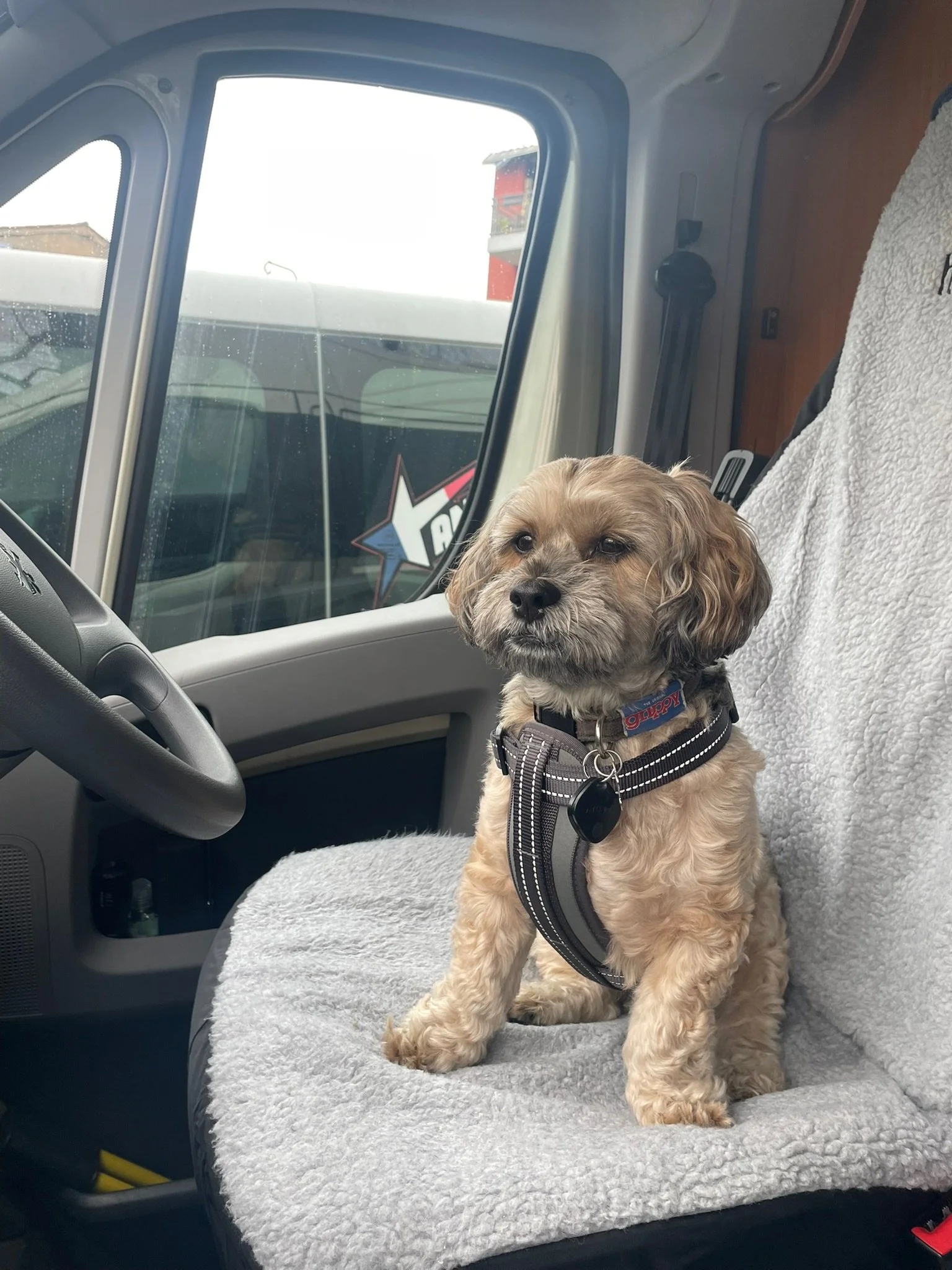
Kate, Charlie, Huffle & Brigitte
Kettle & Keys
comfort, wherever you park up.
Some links in this post are affiliate links, marked with [affiliate]. This means if you buy through them, we earn a small commission – at absolutely no extra cost to you. We only ever link to things we have genuinely used and would recommend to a friend regardless. It’s one of the ways we keep Kettle & Keys running, and we’re grateful for every click. Thank you for supporting us.